ConversationalVoice converts a broad range of real-world recordings into curated training data for full-duplex speech models.
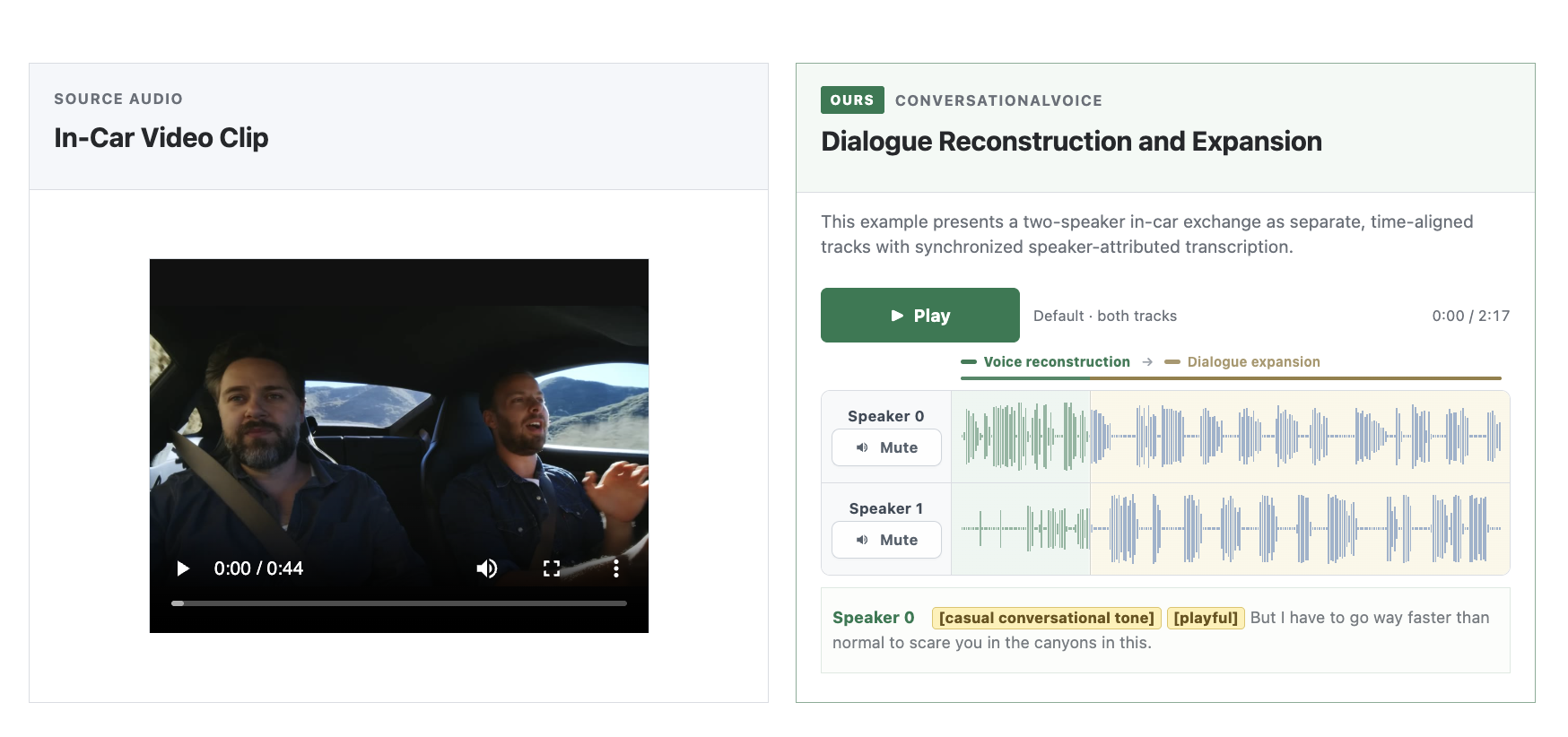
ConversationalVoice converts a broad range of real-world recordings into curated training data for full-duplex speech models. The pipeline identifies two-speaker exchanges, separates the speakers into individual tracks, validates speaker consistency, annotates timing and speaker attributes, and uses each exchange as the basis for new dialogue while preserving its turn-taking, pauses, overlap, and paralinguistic cues.
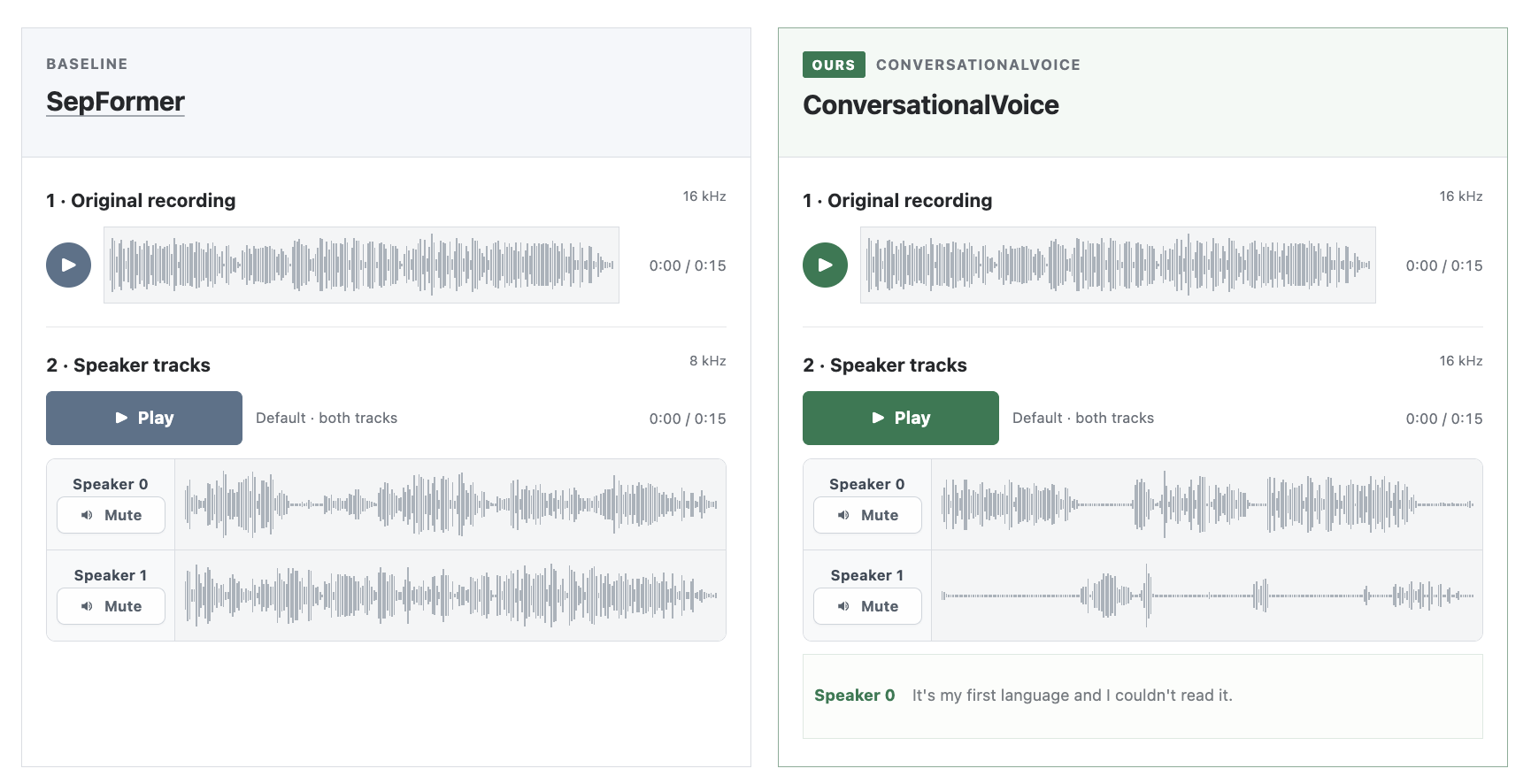
Several available models perform speaker separation, but they remain prone to characteristic speaker-assignment errors: speech from one speaker may be split across multiple tracks, while speech from multiple speakers may be assigned to the same track. Either failure compromises training data for full-duplex speech models, which depend on consistent speaker identity, clean signals, and accurate time alignment.
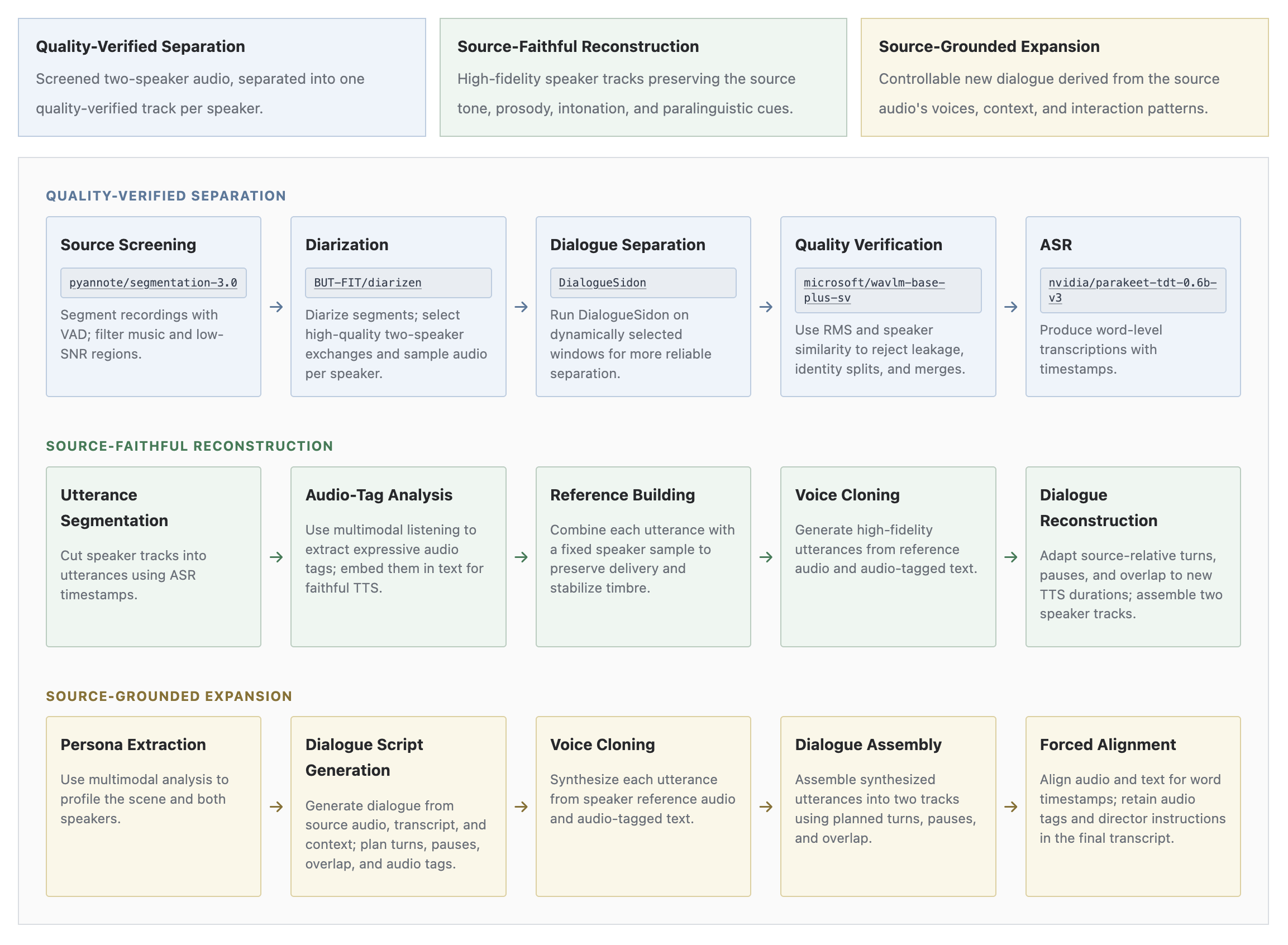
Following an evaluation of several candidate models, we developed an end-to-end separation workflow. VAD first partitions hour-scale recordings at natural boundaries into segments of roughly 15 minutes. In our evaluation, applying Diarizen to these shorter inputs improved speaker attribution. After removing music and low-SNR regions, a greedy dynamic-window search selects the longest eligible segments that contain exactly two speakers, sustain reciprocal interaction without extended monologues, and provide sufficient speech from each participant for reliable DialogueSidon separation. Speaker-consistency checks then identify identity splits and merges. Segments that fail the quality gate are either reprocessed or excluded.
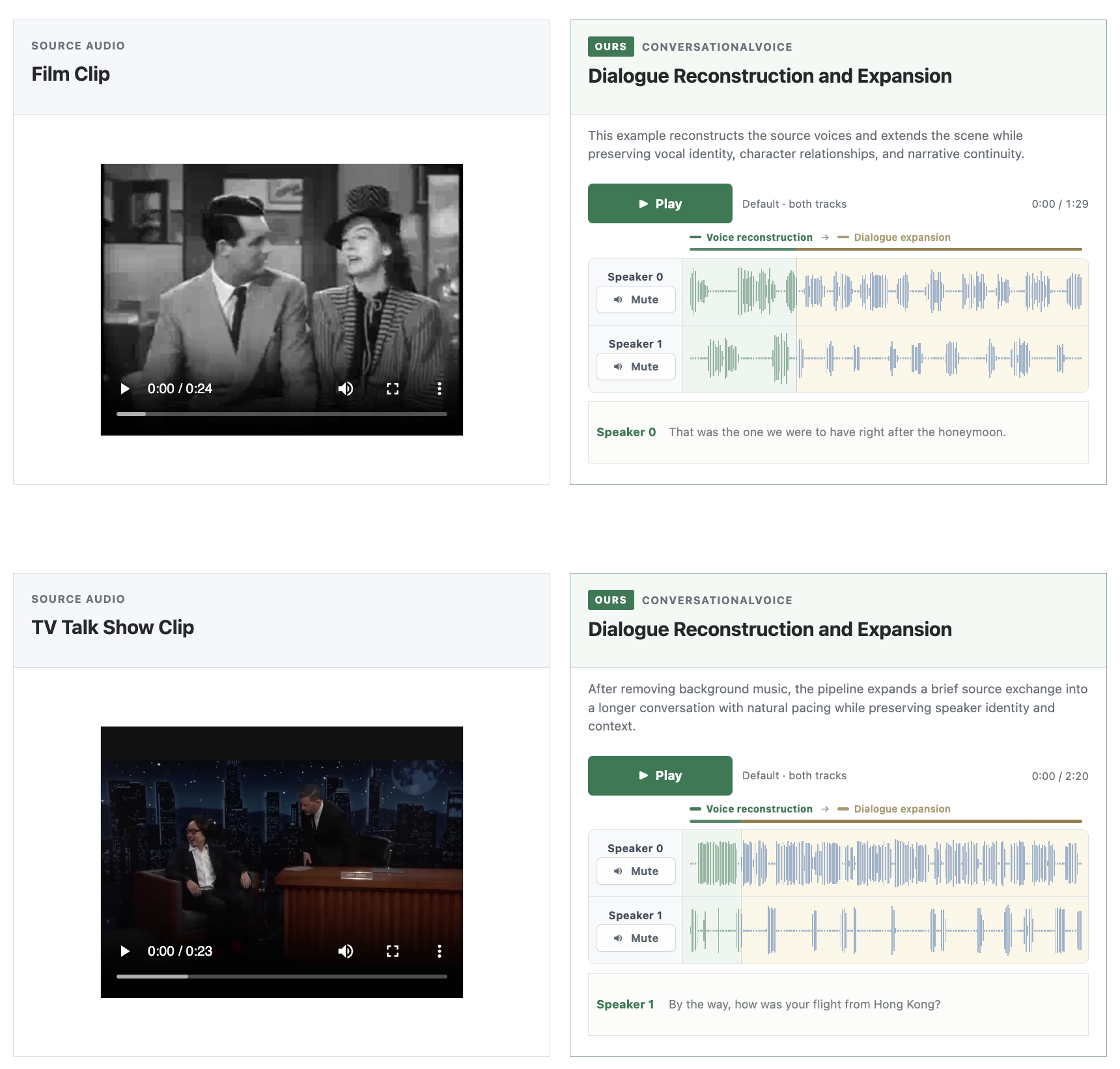
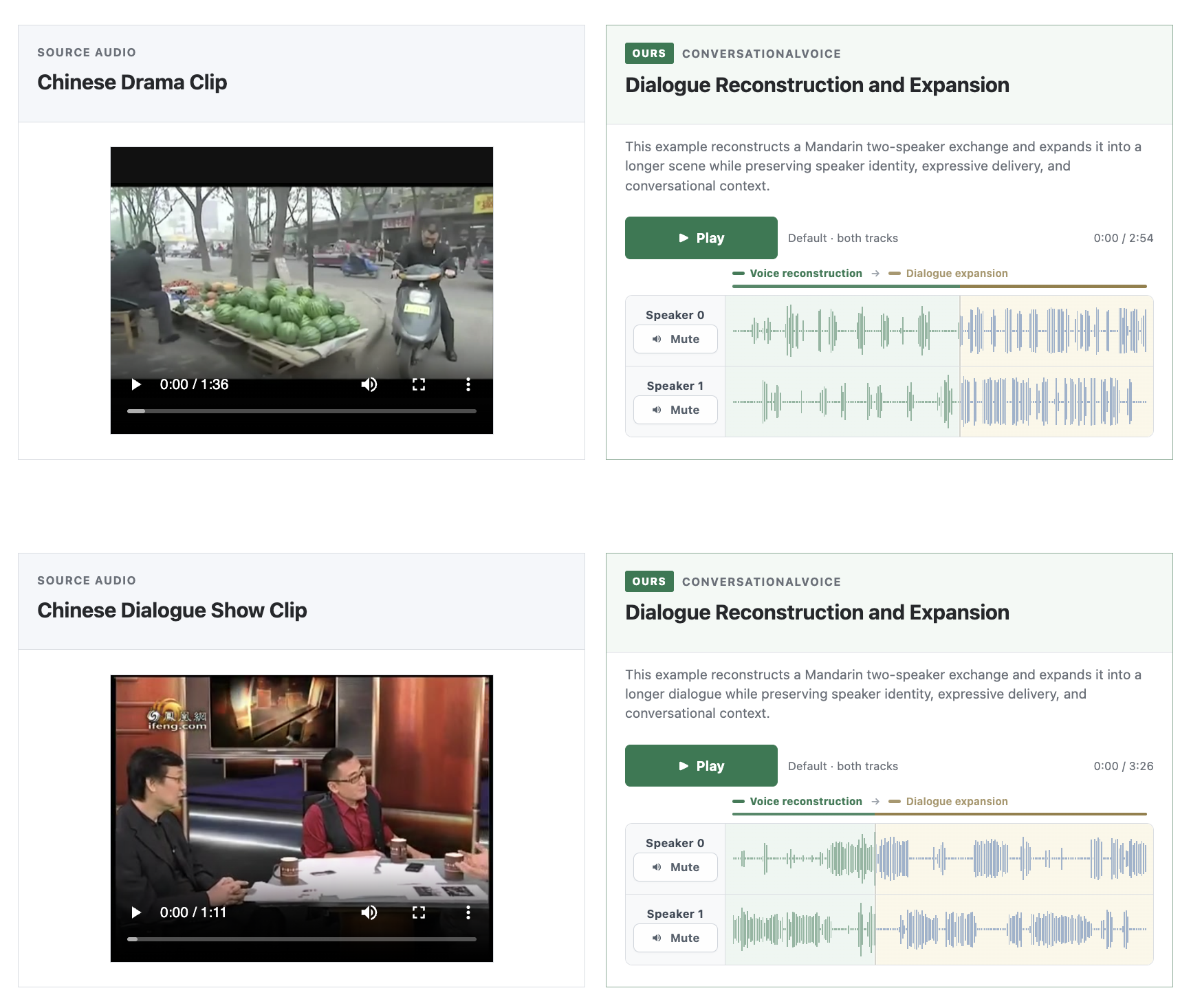
Reconstruction synthesizes clean, high-fidelity dialogue from separated speaker tracks while preserving the expressive character of the original performance. A multimodal model analyzes each utterance and generates audio tags that describe its prosody, emotional tone, and other vocal cues. For TTS, the reference audio is formed by concatenating two complementary sources: a fixed, clean speaker sample that anchors speaker identity and the corresponding utterance from the separated track, which provides utterance-specific guidance for delivery and paralinguistic expression. The reconstructed utterances are then reassembled to preserve the source conversation’s turn order, pauses, and overlap, with timing adjusted to accommodate their synthesized durations while maintaining natural conversational pacing.
Scripts generated from prompts alone can be fluent but often lack the intent, cadence, and context of a real exchange. Template-based dialogue TTS compounds the problem by imposing regular pauses and mechanically scheduled overlap.
ConversationalVoice uses a real exchange as its structural and contextual reference. The observed content, speaker profiles, pauses, and overlap serve as reference points, while up to five minutes of preceding dialogue provides broader context. The expansion stage can increase the volume and diversity of training data or target specific interaction patterns, including turn-taking, pause structure, overlap, and paralinguistic cues.
ConversationalVoice produces speaker-attributed transcripts with Audio Tags and Director Instructions alongside utterance-level and word-level timestamps, preserving the expressive and temporal details of each exchange. These annotations guide expressive, context-faithful TTS generation while providing valuable supervision labels for training.
The pipeline is language-agnostic by design; its effective language coverage is determined by the capabilities of the component models. The default configuration currently supports eight languages: English, Chinese, German, Spanish, French, Italian, Portuguese, and Russian.
Extending coverage does not require changes to the overall pipeline architecture. Additional languages can be enabled, subject to model availability, by substituting compatible models for the three language-dependent components: ASR, forced alignment, and TTS.
Project-authored code is licensed under the Business Source License 1.1 and converts to the MIT License four years after release. Non-production and non-commercial academic use are permitted; other production use requires a commercial license from AveraLabs. Third-party components, including model weights, remain subject to their own terms; see the Third-Party Notices.
Join leading enterprises using AveraLabs to deliver human-level service at AI speed

© 2025 AveraLabs